
Lake County Court Records After Arrest
A Lake County arrest starts with law-enforcement and booking data. The court record starts when a case is opened or updated in Lake County District Court. The Lake County Attorney's Office prosecutes felonies, gross misdemeanors, and misdemeanors that occur in the county, so that office is the bridge between a jail booking and a filed criminal case. The attorney's page also says the office represents Lake County in civil matters, initiates CHIPS petitions, and handles involuntary commitment matters, but it does not represent private citizens or give private legal advice.
Booking charges and court charges should be compared carefully. The jail roster may show the arrest or booking allegation. The prosecutor may file different charges, amend a count, decline a count, add a count, or dismiss a charge later. For custody and booking detail, use Lake County jail inmate records. For booking photos, use Lake County jail mugshots. For filed charges, hearings, and dispositions, search the court record.
Find Lake County Court Records After Arrest
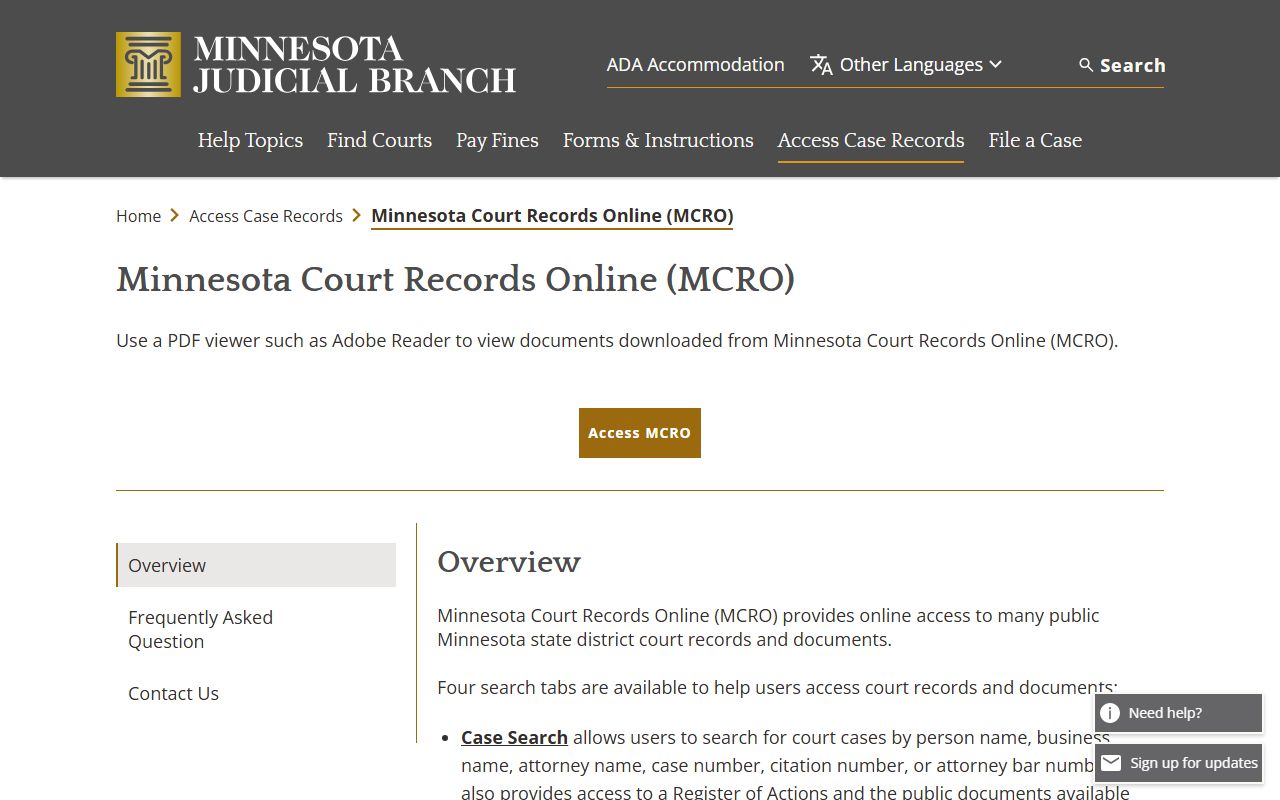
Minnesota Court Records Online is the main remote portal for public Minnesota district court records. The MCRO overview explains the case, document, hearing, and judgment search tabs, while the MCRO access page is the direct route into the system. MCRO is not the certified court record. Certified copies and official civil judgment search results come from court administration.
- Start with the jail roster name, booking date, charge text, or citation number if known.
- Search MCRO by defendant name, case number, citation number, or attorney information.
- Filter for Lake County and the Sixth Judicial District when multiple cases appear.
- Open the Register of Actions to read hearings, filings, charge events, and disposition entries.
- Contact Lake County District Court for certified records, older documents, or records available only at a courthouse terminal.
The Minnesota MCRO overview shows the statewide court-record search choices used for Lake County cases.
Use the court portal to confirm filed charges, not to verify whether someone is still physically in the Lake County Jail.
Lake County Court Search Fields
MCRO gives several search paths for court records after an arrest. Name searches help when only a roster result is known. Case-number or citation-number searches are better when the roster, citation, attorney, or court notice provides exact identifiers. Document search is narrower because it uses a case number for public online documents.
| Search or Tab | Field Type | Required | Notes |
|---|---|---|---|
| Case Search | Search form | Depends on method | Search by person name, business name, attorney name, case number, citation number, or attorney bar number. |
| Document Search | Search form | Case number | Search by case number for public online documents. |
| Hearing Search | Search form | Depends on method | Search by person, business, case number, judicial officer, attorney, or bar number. |
| Judgment Search | Search form | Debtor name | Search docketed money judgment details and satisfactions. |
Lake County District Court Records
Lake County District Court is at the Lake County Courthouse, 601 Third Avenue, Two Harbors, MN 55616. The court phone is (218) 595-5001, and business hours are Monday through Friday, 8:00 AM to 4:30 PM. The court has original jurisdiction over civil, family, probate, juvenile, criminal, and traffic cases filed in Lake County and is part of Minnesota's Sixth Judicial District.
The court page says a public access to court records computer is available at the courthouse. Court calendars are posted at 7:00 AM each business day and updated hourly, but a calendar is not the full case record. Some public records may be available at courthouse terminals but not remotely online. Free surface-lot and on-street parking are listed for the courthouse complex.
Charges Filed After Lake County Arrest
The first filed criminal document is the point where a jail arrest turns into a court case. Minnesota practice commonly uses complaints and citations in criminal and traffic matters. A grand-jury indictment can exist in serious cases, but nothing in the Lake County research suggested that every arrest follows that route. The point is the same: the filed court document controls the court record, while the roster shows custody and booking information.
| Document | What It Does | Where to Check |
|---|---|---|
| Complaint | States the prosecutor's formal criminal allegations and facts supporting charges. | MCRO documents or court administration when public. |
| Citation | Can start a traffic or lower-level criminal case tied to a citation number. | MCRO case or citation search. |
| Indictment | Grand-jury charging document for serious cases when used. | Court file and case events. |
Lake County Charge Status Records
Charge status can change many times after a jail arrest. A pending charge means the court case is still open or unresolved. An amended charge means the filed count changed. A dismissal means the court no longer proceeds on that count, though other counts may remain. A conviction appears only after a plea, verdict, and sentencing or disposition event. Use the Register of Actions and public documents together because one short status label may not tell the whole case story.
| Status | Meaning | Why It Matters |
|---|---|---|
| Pending | The charge or case has not reached final disposition. | Future hearings, bond, and conditions may still apply. |
| Amended | The prosecutor or court changed the charge text, level, or count. | Do not rely only on the original roster charge. |
| Dismissed | The count is no longer being prosecuted in that case. | A dismissed charge is not a conviction. |
| Convicted | A plea or verdict led to a finding of guilt and disposition. | Sentence, probation, jail, or prison consequences may follow. |
Bail Records After Lake County Arrest
Lake County's jail page says cash bail may be posted at the facility at any time, and the jail does not accept personal checks, credit cards, or debit cards for bail. Bail may also be posted through a bonds person of the user's choice. Do not confuse the sheriff's online fee-payment link with online cash-bail payment unless the sheriff confirms that option for the specific case.
| Release Type | Meaning | Lake County Note |
|---|---|---|
| Cash bail | Money paid directly to secure release. | May be posted at the jail any time, but no personal checks, credit cards, or debit cards. |
| Surety bond | A bonds person posts bond under bonding rules. | Lake County says a bonds person of choice may be used. |
| Personal recognizance | Release on promise or order to appear. | Controlled by court order under Minnesota pretrial release law. |
| Hold or no bond | Release is blocked by this case or another agency. | Check court, warrant, probation, DOC, ICE, or other-county holds. |
Warrants and Lake County Arrest Records
The Lake County Sheriff page links a Warrant List, and Citizen RIMS endpoint names suggest the public-safety app supports warrant-list data. The full warrant form labels and sample records were not captured in static research, so the sheriff's warrant route should be treated as the official online starting point with phone and court fallbacks. A warrant may lead to a jail booking when a person is arrested and lodged at Lake County Jail.
For a bench warrant after missed court, search MCRO for the underlying criminal or traffic case. For a DOC fugitive issue, use MNDOC fugitive tools and the DOC tip line. Federal warrants are handled through federal court and the U.S. Marshals Service, and they may not appear on a county warrant list. Do not ignore a warrant, and do not assume a phone result fully resolves the court issue.
Charges Versus Convictions
A jail arrest, filed charge, and conviction are three different stages. Arrest means law enforcement took the person into custody. A charge means the prosecutor or citation process accused the person in court. A conviction means guilt was established by plea, verdict, and disposition. The distinction matters for employment, housing, licensing, family, and record-clearing questions.
| Record Type | What It Means | What It Does Not Prove |
|---|---|---|
| Arrest or booking | Law enforcement took a person into custody and created a jail record. | It does not prove guilt. |
| Filed charge | The prosecutor or citation process opened a criminal court allegation. | It may later be amended or dismissed. |
| Conviction | The case ended in guilt by plea or verdict with court disposition. | It does not describe every original arrest allegation. |
Sealed and Expunged Court Records
Minnesota uses Chapter 609A for criminal-record expungement. Expungement is a court process, not an automatic deletion from every record system. A dismissed charge, acquittal, eligible conviction, or other qualifying outcome may require a petition or statutory process. The public court record can also differ from jail, law-enforcement, prosecutor, and private copies already made before relief was granted.
| Term | Plain Meaning | Lake County Search Effect |
|---|---|---|
| Sealed | Public access is restricted by court order or law. | The case may not appear remotely or may show limited detail. |
| Expunged | Records are sealed or access is limited under Minnesota Chapter 609A. | Ask the court about the scope of any order. |
| Confidential or private | Law limits public release of the record. | Juvenile, medical, security, and some investigation data may be withheld. |
Limits on Lake County Court Records
MCRO provides online access to many public Minnesota district court records and documents, including public documents filed on or after July 1, 2015 in major and minor criminal and civil case types, plus certain court-generated documents from July 1, 2005 through June 30, 2015. Some public records are available at courthouse terminals but not online. Juvenile matters, sealed records, and nonpublic data can be restricted.
Important: A casual court lookup is not an FCRA consumer report and must not be used for regulated screening decisions.
Public Record Search
Sponsored Results